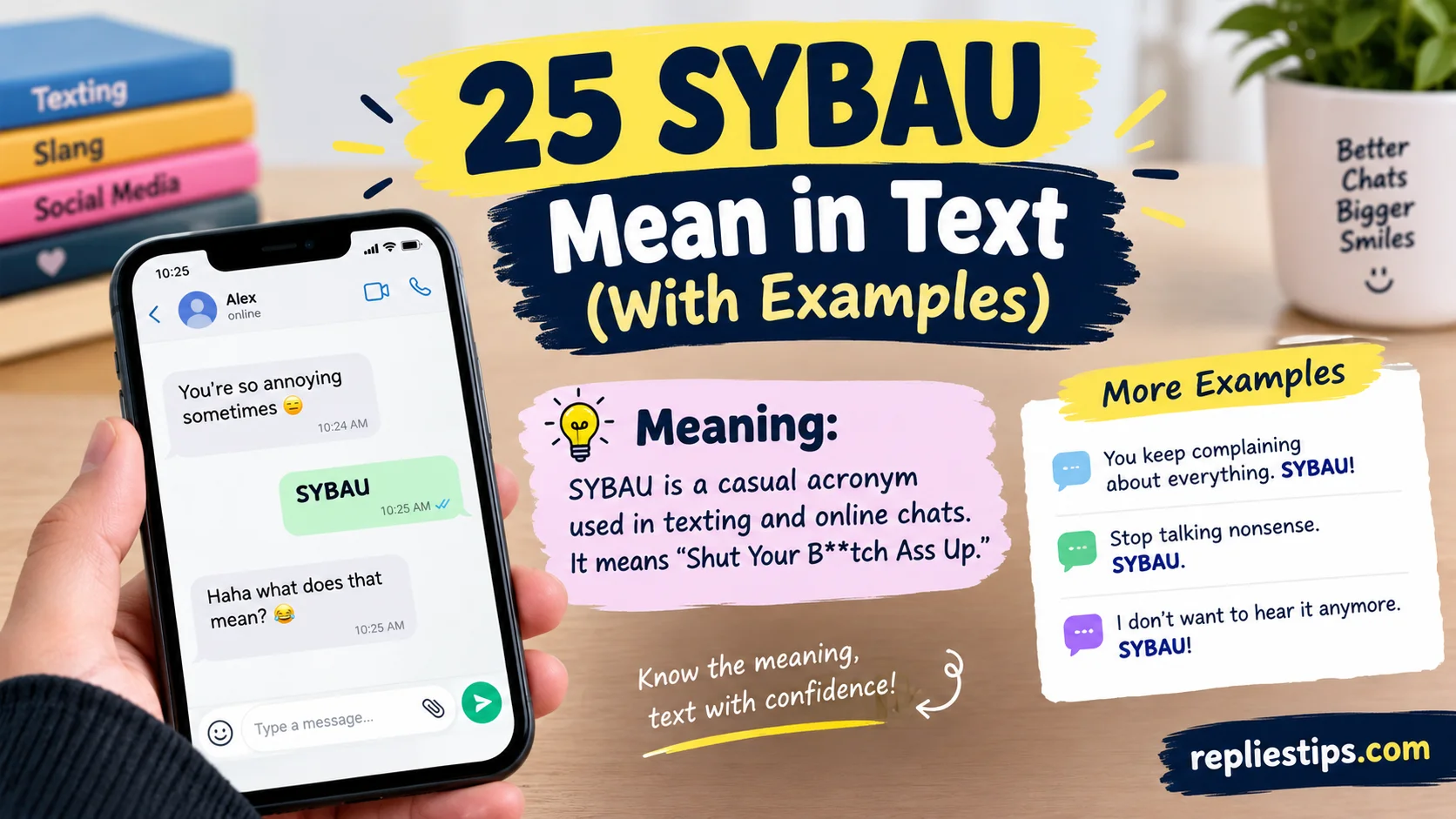
SYBAU meaning in text refers to the slang phrase “Shut Your Bitch Ass Up.” People commonly use this abbreviation on TikTok, Snapchat, Instagram, and in gaming chats. It can express anger, sarcasm, or humor, depending on the conversation. Although friends may use SYBAU jokingly, it can also sound rude or offensive. Understanding this internet slang helps you recognize its meaning and avoid misunderstandings when reading online messages.
The meaning of SYBAU depends on the context, the sender’s intention, and the overall tone. For example, friends might use it in a funny exchange, while strangers may use it as an insult during an argument. Before replying, consider the previous messages and your relationship with the sender. If the message feels disrespectful, you can ignore it or respond calmly. Recognizing this Gen Z slang helps you understand modern online communication and choose an appropriate response.
1. What Does SYBAU Mean in Text?
The SYBAU meaning in text is generally “shut your bitch ass up.” It is a vulgar internet abbreviation used to tell someone to stop talking, often in a dismissive, sarcastic, or confrontational way. However, its exact tone depends on the conversation. Friends might use it as exaggerated banter after someone makes a ridiculous joke, while strangers may use it to insult someone during an argument. You may encounter SYBAU in text messages, TikTok comments, memes, and gaming chats. Since the expression contains profanity, it is not appropriate for every audience. Before interpreting it as a serious insult, consider the relationship between the people involved and the surrounding messages.
Meaning: Shut your mouth in a rude or dismissive way.
Tone: Vulgar, sarcastic, joking, or aggressive.
Example: “SYBAU bro, nobody asked 😂”
Best Use: Recognizing casual internet slang rather than using it in formal conversations.
2. What Does SYBAU Stand For?
SYBAU commonly stands for “shut your bitch ass up.” Each part contributes to the phrase’s aggressive and informal tone. The abbreviation allows internet users to communicate the expression quickly without typing the complete sentence. Although some people use it humorously, the wording is still profane and can easily offend someone who does not appreciate that style of communication. Its meaning is usually clear when someone responds to an annoying comment, an exaggerated claim, or a joke they consider ridiculous. However, abbreviations can have different interpretations in unusual contexts, so the surrounding conversation remains important when deciding what a particular person intends.
Meaning: An abbreviated command telling someone to stop talking.
Tone: Blunt, disrespectful, humorous, or hostile.
Example: “SYBAU, you did not just say that.”
Best Use: Understanding the full phrase when you encounter the abbreviation online.
3. SYBAU Meaning on TikTok
On TikTok, SYBAU frequently appears in comment sections, reaction videos, memes, and conversations between users. Someone might post an unpopular opinion, make an exaggerated claim, or share an embarrassing moment, and another user may respond with SYBAU. In some communities, the expression functions as a dramatic reaction rather than a serious attempt to start a fight. Emojis, video context, and the relationship between commenters can help clarify the intention. Still, a public comment can feel more insulting than a private joke because other people may join in. Understanding the slang helps you interpret TikTok conversations without assuming that every use is friendly or harmless.
Meaning: A blunt reaction telling a TikTok user to stop talking.
Tone: Meme-driven, sarcastic, mocking, or aggressive.
Example: “Bro explained his dream for ten minutes 💀 SYBAU.”
Best Use: Understanding reactions and internet humor in TikTok comment sections.
4. SYBAU Meaning on Snapchat
On Snapchat, SYBAU can appear in direct messages, group chats, or replies to snaps. Friends may use it after someone shares an embarrassing picture, makes a silly statement, or continues teasing them. In these situations, the phrase can be part of established banter between people who understand each other’s humor. However, the same message from a new acquaintance or someone who seems angry may come across as disrespectful. Snapchat’s informal communication style does not automatically make every rude phrase friendly. If you receive SYBAU, look at the preceding messages, any emojis, and the sender’s usual communication style before deciding whether to laugh, respond, or set a boundary.
Meaning: A rude or joking command to stop talking.
Tone: Casual, teasing, annoyed, or insulting.
Example: “SYBAU 😭 you always exaggerate everything.”
Best Use: Interpreting slang in informal Snapchat conversations.
5. SYBAU Meaning on Instagram
Instagram users may write SYBAU beneath Reels, in comment threads, or in private messages. It often appears as a reaction to an opinion, joke, video, or statement that someone finds annoying or unbelievable. For example, a user might make a confident claim about a celebrity, and another person may respond with SYBAU to dismiss it. Sometimes the exchange is playful, especially among friends who regularly tease one another. In other cases, the abbreviation is used to provoke or embarrass someone publicly. Because comments can be read by a wide audience, it is worth considering how the wording might affect the conversation before repeating it.
Meaning: A profane way to tell someone to be quiet.
Tone: Dismissive, mocking, playful, or hostile.
Example: “SYBAU, that take makes absolutely no sense 💀”
Best Use: Recognizing slang in Instagram comments, Reels, and DMs.
6. SYBAU Meaning in Text Messages
In ordinary text messages, SYBAU is a shortened way of telling someone to stop talking, usually with a vulgar edge. Its meaning depends heavily on who sends it and what happened immediately beforehand. A close friend might send it after a ridiculous joke, expecting the recipient to laugh. Someone during a disagreement might use the same abbreviation to show anger or contempt. Unlike a neutral phrase such as “please stop,” SYBAU can sound deliberately disrespectful. If the sender’s intention is unclear, asking what they mean may be more helpful than responding with another insult. Context, familiarity, and communication style all influence how the message is understood.
Meaning: A slang command telling someone to stop speaking.
Tone: Informal, rude, joking, or confrontational.
Example: “SYBAU 😂 I cannot believe you actually tried that.”
Best Use: Understanding casual messages from friends or online acquaintances.
7. Is SYBAU a Bad Word?
Yes, SYBAU is generally considered offensive because its commonly understood full form includes profanity. Although the abbreviation hides the complete wording, most people familiar with the slang understand what it means. Some internet users treat it as ordinary meme language, but that does not make it universally acceptable. Parents, teachers, employers, and people who prefer respectful communication may view it as inappropriate. The phrase can also cause misunderstandings when people from different age groups or online communities communicate. If you want to express disagreement without offending someone, alternatives such as “please stop,” “that’s enough,” or “I disagree” are usually safer.
Meaning: An abbreviation containing offensive language.
Tone: Vulgar, disrespectful, or jokingly aggressive.
Example: “He commented SYBAU, but the teacher saw the message.”
Best Use: Understanding why the expression may be inappropriate in certain settings.
8. Is SYBAU an Insult?
SYBAU can certainly be an insult, especially when someone uses it to humiliate another person, dismiss their opinion, or shut down a serious conversation. Its vulgar wording makes it more aggressive than a simple request to be quiet. However, it is not always intended as a genuine attack. Friends sometimes use the phrase as exaggerated teasing, particularly when they share a sarcastic sense of humor. The difference often becomes clear through the relationship, the conversation’s emotional tone, and the reaction afterward. If the message makes you uncomfortable, you do not have to accept it as harmless simply because the sender claims it was a joke.
Meaning: A potentially insulting expression used to silence someone.
Tone: Disrespectful, teasing, sarcastic, or hostile.
Example: “I shared my opinion, and he replied, ‘SYBAU.’”
Best Use: Identifying whether an online comment crosses a personal boundary.
9. Is SYBAU a Joke or an Insult?
SYBAU can function as either a joke or an insult, depending on the situation. Among close friends, it may be an exaggerated reaction to an outrageous statement or an intentionally terrible joke. Laughing emojis, familiar teasing, and a relaxed conversation can suggest playful intent. However, if someone uses the phrase during a heated argument, repeatedly directs it at you, or posts it to embarrass you publicly, it may be meant to hurt rather than entertain. Text-based communication makes tone difficult to judge because facial expressions and voice are missing. Instead of focusing only on the abbreviation, consider the sender’s behavior and how the interaction makes you feel.
Meaning: A phrase that can communicate teasing or disrespect.
Tone: Playful, sarcastic, irritated, or aggressive.
Example: “SYBAU 😭 that was the worst joke I’ve ever heard.”
Best Use: Interpreting the intention behind a slang message.
10. SYBAU Meaning in Gen Z Slang
In Gen Z internet slang, SYBAU is commonly used as a sharp, humorous, or confrontational reaction. Younger internet users often shorten expressions to make comments quicker and more recognizable within online communities. SYBAU fits this pattern because it conveys a strong reaction using just five letters. It can appear alongside emojis, exaggerated reactions, and other informal expressions. However, slang is not universal, and not everyone in Gen Z uses or appreciates the abbreviation. Its meaning may also spread across different age groups through social media. Understanding the phrase is more useful than assuming that every person who uses it shares the same intentions or communication style.
Meaning: A widely recognizable vulgar internet abbreviation.
Tone: Sarcastic, humorous, dismissive, or confrontational.
Example: “SYBAU 💀 nobody believes that story.”
Best Use: Understanding informal online language and generational slang.
11. How to Use SYBAU in a Conversation
People generally use SYBAU as a reaction when they want someone to stop talking, challenge a ridiculous claim, or respond dramatically to a joke. For instance, a friend might make an obviously exaggerated statement, and another person could reply with the abbreviation as playful banter. Nevertheless, the phrase is deliberately rude, so using it without understanding your audience can create unnecessary conflict. It is especially risky when speaking with strangers, communicating with authority figures, or discussing something emotionally important. If you decide to use it in a casual conversation, remember that the recipient may interpret it more seriously than you intended.
Meaning: A slang expression used to tell someone to stop talking.
Tone: Blunt, joking, or disrespectful.
Example: “SYBAU bro, you keep changing the story.”
Best Use: Recognizing informal banter while respecting other people’s boundaries.
12. SYBAU Examples in Text Messages
Examples make it easier to understand how SYBAU changes meaning depending on context. In a friendly group chat, the abbreviation might follow a ridiculous joke or a surprising confession. During an argument, it could communicate anger, impatience, or an unwillingness to listen. Consider these examples: “SYBAU, you’re making this story up,” “SYBAU 😂 that outfit is actually wild,” and “Please stop messaging me like that” as a more respectful alternative. Notice how emojis and wording influence the tone, although they cannot guarantee that a message will be received positively. Reading the entire exchange is more reliable than judging a single abbreviation.
Meaning: A vulgar reaction used in different texting situations.
Tone: Depends on context, relationship, and surrounding words.
Example: “SYBAU 😭 why would you even say that?”
Best Use: Learning how the abbreviation appears in everyday digital conversations.
13. Funny SYBAU Examples
Funny SYBAU examples usually involve exaggeration, harmless teasing, or an unexpected response to something ridiculous. Friends might use the expression when someone tells a painfully bad joke, makes an unbelievable excuse, or keeps repeating a story everyone already knows. In meme culture, the humor often comes from the dramatic wording rather than genuine anger. For instance, “SYBAU, you burned water” might be used to tease a friend about cooking. Even so, humor depends on the people involved. A joke that feels normal in one friendship may seem hurtful to another person. Avoid using the expression to target someone’s insecurities or embarrass them in front of others.
Meaning: A dramatic slang reaction used for comedic effect.
Tone: Playful, sarcastic, exaggerated, or teasing.
Example: “SYBAU 😭 you put the cereal in before the milk debate is crazy.”
Best Use: Understanding humorous exchanges between friends who enjoy sarcastic banter.
14. Rude and Sarcastic Uses of SYBAU
SYBAU can sound particularly rude when someone uses it to dismiss another person’s thoughts instead of discussing the issue. Sarcastic versions often appear in arguments, comment sections, or conversations where one person believes the other is being unreasonable. For example, someone might respond to a long explanation with “SYBAU, nobody asked for a lecture.” The wording is intentionally dismissive and may escalate the disagreement. Sarcasm does not automatically make a message harmless, especially when it targets a stranger or someone who is already upset. If your goal is to resolve a conflict, a clear explanation of your disagreement is usually more effective than an insult.
Meaning: A disrespectful command to stop talking.
Tone: Harsh, sarcastic, mocking, or hostile.
Example: “SYBAU, you’re not even answering the question.”
Best Use: Recognizing when online sarcasm becomes disrespectful communication.
15. SYBAU Meaning in Online Gaming
In online gaming, SYBAU may appear in team chats, livestream chats, multiplayer matches, or conversations between gaming friends. Players sometimes use it after an opponent boasts about winning, a teammate makes an unexpected mistake, or another user sends an irritating message. In competitive settings, the abbreviation can become part of trash talk intended to provoke a reaction. Among friends, it may simply be exaggerated banter after a funny moment. However, gaming communities include people with different ages and expectations, so offensive language can create problems. Players should also be aware that individual games and platforms may restrict abusive chat. A competitive match does not make every insult acceptable.
Meaning: A vulgar gaming-chat reaction telling someone to be quiet.
Tone: Competitive, mocking, playful, or aggressive.
Example: “SYBAU, the match isn’t even over yet 💀”
Best Use: Understanding gaming slang without encouraging harassment or abusive behavior.
Read More: 25 RCS Mean in Texting (With Examples)
16. What Does SYBAU Mean in Comments?
When SYBAU appears in an online comment, it generally signals that the commenter wants to dismiss, criticize, or jokingly silence another person. It may be posted beneath a controversial opinion, an awkward video, an exaggerated story, or a comment that other users find annoying. The phrase can attract attention because it is short and emotionally forceful. However, a comment’s public setting can make the wording feel more humiliating than the same expression in a private conversation. Other people may join the discussion, turning one rude remark into a larger argument. Before interpreting a comment as playful, consider whether the participants seem friendly or whether the exchange is becoming hostile.
Meaning: A profane reaction used to shut down a comment.
Tone: Dismissive, sarcastic, mocking, or aggressive.
Example: “SYBAU, bro wrote an entire essay in the comments.”
Best Use: Interpreting slang in public comment sections and online discussions.
17. How to Reply to SYBAU
The best response to SYBAU depends on whether the sender is joking, genuinely annoyed, or trying to provoke you. If a close friend uses it playfully and you are comfortable with the joke, you might respond with laughter or a lighthearted comment. If the message feels disrespectful, you can ask the person to speak more respectfully or simply end the conversation. For example, “What’s your problem?” may communicate frustration, but it can also escalate an argument. A calmer response, such as “You can disagree without talking to me like that,” establishes a clearer boundary. You do not have to respond immediately or match the sender’s language.
Meaning: Choosing an appropriate response to a rude slang message.
Tone: Calm, humorous, assertive, or neutral.
Example: “You can make your point without insulting me.”
Best Use: Responding to SYBAU without unnecessarily escalating a disagreement.
18. Polite Responses to SYBAU
A polite response to SYBAU can help you maintain control of a conversation without returning the insult. This approach is useful when you do not know the sender well, when the discussion matters, or when you want to avoid unnecessary drama. You might say, “Please speak respectfully,” “Let’s keep this conversation civil,” or “If you disagree, explain why.” These replies acknowledge the problem without relying on profanity. Sometimes, ignoring a provocative message is also a reasonable option, particularly when the sender appears interested in an argument rather than a genuine discussion. Choosing a respectful response does not mean accepting disrespect; it means deciding how you want to handle it.
Meaning: Responding to an offensive message with respectful language.
Tone: Calm, mature, firm, and non-confrontational.
Example: “I’m happy to talk, but please keep it respectful.”
Best Use: School discussions, professional conversations, and tense online exchanges.
19. Funny Comebacks to SYBAU
If someone sends SYBAU as friendly teasing, a funny comeback may keep the conversation light without turning it into a serious argument. You could respond with “After that terrible joke? Never,” “You started this conversation 😂,” or “My commentary is part of the entertainment.” These replies focus on the situation instead of attacking the other person’s appearance, identity, or personal circumstances. However, humor works best when both people understand the joke and feel comfortable with the exchange. If the sender is genuinely angry or repeatedly insulting you, a clever comeback may only prolong the conflict. In those situations, setting a boundary or disengaging can be a better choice.
Meaning: A humorous response to someone using SYBAU.
Tone: Witty, playful, sarcastic, or confident.
Example: “You first 😂 I’m waiting for the good argument.”
Best Use: Friendly banter when both people are comfortable with teasing.
20. When Should You Avoid Using SYBAU?
You should avoid using SYBAU in situations where respectful communication matters or where the recipient may reasonably feel insulted. Examples include professional emails, school assignments, workplace chats, customer service conversations, and serious discussions with family members. It is also wise to avoid the phrase when messaging strangers or interacting with someone whose sense of humor you do not understand. Because the abbreviation contains profanity, the recipient may interpret it as aggression even if you intended it as a joke. If you want to express annoyance, you can choose clearer alternatives, such as “Please stop,” “I don’t agree,” or “Let’s change the subject.” These options communicate your point without unnecessary hostility.
Meaning: Recognizing when SYBAU is inappropriate.
Tone: The original phrase is vulgar and potentially offensive.
Example: Instead of “SYBAU,” write, “Please let me finish speaking.”
Best Use: Choosing respectful language in formal, sensitive, or unfamiliar situations.
21. SYBAU vs. STFU
SYBAU and STFU both communicate that someone should stop talking, but their wording differs. STFU stands for “shut the fuck up,” while SYBAU commonly stands for “shut your bitch ass up.” Both contain profanity and can sound hostile, although friends may sometimes use them jokingly. Their perceived intensity depends on the situation, the relationship between the speakers, and the way the message is delivered. Neither abbreviation is automatically friendly simply because it appears in a meme or group chat. If you are trying to understand a conversation, look at the context rather than assuming the expressions are interchangeable in every situation.
Meaning: Both phrases are vulgar ways of telling someone to be quiet.
Tone: Rude, sarcastic, joking, or confrontational.
Example: “He wrote STFU, while another person replied with SYBAU.”
Best Use: Understanding the difference between two common internet abbreviations.
22. SYBAU vs. Shut Up
“Shut up” is a direct command asking someone to stop speaking. Depending on delivery, it can sound playful, impatient, or rude. SYBAU communicates a similar basic idea but usually adds a more vulgar and insulting edge because of its commonly understood full form. For example, a friend might say “Shut up, that’s amazing!” to express surprise rather than anger. The same reaction with SYBAU would be more profane and could be interpreted as an insult. Both expressions depend on context, but “please be quiet” or “let me finish” provides a more respectful alternative when you want to communicate clearly without provoking someone.
Meaning: Both expressions can tell someone to stop talking.
Tone: “Shut up” varies by context; SYBAU is generally more vulgar.
Example: “Please be quiet while I explain the situation.”
Best Use: Choosing the right wording for the audience and situation.
23. Why Is SYBAU Trending Online?
SYBAU spreads through the same informal communication habits that help many internet abbreviations become recognizable. Short phrases are easy to type, repeat in comments, and incorporate into memes or reaction videos. Its blunt wording also makes it useful for exaggerated reactions, sarcastic jokes, and online arguments. When a phrase appears repeatedly in a particular community, users may begin recognizing it even if they do not use it themselves. However, popularity on social media does not mean everyone understands the abbreviation or considers it acceptable. Slang can change over time, and its meaning may shift slightly between communities. Understanding the common definition and its vulgar tone is more useful than assuming that every use follows one trend.
Meaning: SYBAU is internet slang that circulates through online conversations and memes.
Tone: Often sarcastic, humorous, dismissive, or aggressive.
Example: “I kept seeing SYBAU in comments, so I looked up its meaning.”
Best Use: Understanding unfamiliar abbreviations encountered on social media.
24. Is SYBAU Appropriate for School or Work?
Generally, SYBAU is not appropriate for school or work because its commonly understood meaning includes profanity and can sound disrespectful. Sending it to a teacher, colleague, manager, or customer may damage a professional relationship or violate communication rules. Even when a workplace or classroom has a relaxed atmosphere, people may interpret the abbreviation differently. One person might see it as a joke, while another considers it offensive. If you need to disagree with someone, explain the issue directly and respectfully. Phrases such as “I see it differently,” “Could we discuss this calmly?” or “Please let me finish” are clearer and more suitable for professional settings.
Meaning: SYBAU is generally an unsuitable expression for formal communication.
Tone: Vulgar, informal, and potentially disrespectful.
Example: Instead of writing “SYBAU” in a work chat, say, “Let’s stay focused on the issue.”
Best Use: Understanding why professional and educational settings call for more appropriate language.
25. What Does SYBAU Mean From a Friend?
When a friend sends SYBAU, the meaning depends on your relationship and the situation. Some friends use the abbreviation as exaggerated teasing after someone tells an embarrassing story, makes a silly joke, or refuses to stop talking about a favorite topic. If both people enjoy this kind of banter, the message may not cause any serious offense. However, friendship does not automatically make rude language acceptable. If your friend uses SYBAU during a disagreement or continues after you ask them to stop, the expression may reflect frustration or disrespect. Consider the surrounding conversation and how you feel rather than assuming that every message from a friend is harmless.
Meaning: A vulgar expression that a friend may use jokingly or seriously.
Tone: Friendly teasing, sarcasm, irritation, or hostility.
Example: “SYBAU 😂 you have told me that story five times.”
Best Use: Interpreting a friend’s message according to your usual communication style and boundaries.
FAQs:
1. What does SYBAU mean in texting?
SYBAU commonly stands for “shut your bitch ass up.” It is a vulgar slang expression used to tell someone to stop talking. Depending on the context, it can be a joke between friends or a serious insult.
2. What does SYBAU mean on TikTok?
On TikTok, SYBAU often appears in comments, memes, and reaction videos. Users may write it to mock an opinion, react to a ridiculous statement, or tease someone. Its tone can range from playful to offensive.
3. Is SYBAU rude?
Yes, SYBAU is generally considered rude because its full form contains profanity. Some friends use it casually, but others may find it insulting. Consider your audience before using it.
4. What does SYBAU mean on Snapchat?
On Snapchat, SYBAU has the same commonly understood meaning. It may appear in private messages, snap replies, or group chats as a sarcastic reaction or an expression of annoyance.
5. Is SYBAU appropriate for school or work?
Generally, no. SYBAU contains offensive language and may sound disrespectful in professional or educational settings. Use alternatives such as “please stop,” “let me finish,” or “let’s talk respectfully.”
6. How do you reply to SYBAU?
Your response depends on the sender’s intention. You can reply humorously with “You started it 😂” or calmly say, “You can disagree without insulting me.” Ignoring the message is another option if the person is trying to provoke you.
7. What is the difference between SYBAU and STFU?
Both abbreviations tell someone to stop talking. SYBAU commonly means “shut your bitch ass up,” while STFU means “shut the fuck up.” Both are vulgar, although their perceived tone depends on context.
8. Does SYBAU mean the same thing everywhere?
Its common meaning is widely recognized in internet slang, but the intended tone can vary. Some communities use it jokingly, while others use it aggressively. The surrounding conversation helps clarify the intended message.
Conclusion:
The SYBAU meaning in text is commonly understood as “shut your bitch ass up.” It is an informal internet abbreviation that appears on TikTok, Snapchat, Instagram, gaming platforms, and in everyday text messages. Depending on the situation, it can express sarcasm, playful teasing, frustration, or disrespect.
The most important thing is to understand the context before reacting. A close friend may use SYBAU as a joke, while a stranger may intend it as an insult. Since the phrase contains profanity, it is best avoided in professional and formal conversations. Knowing its meaning helps you understand modern internet slang and choose an appropriate response without creating unnecessary conflict