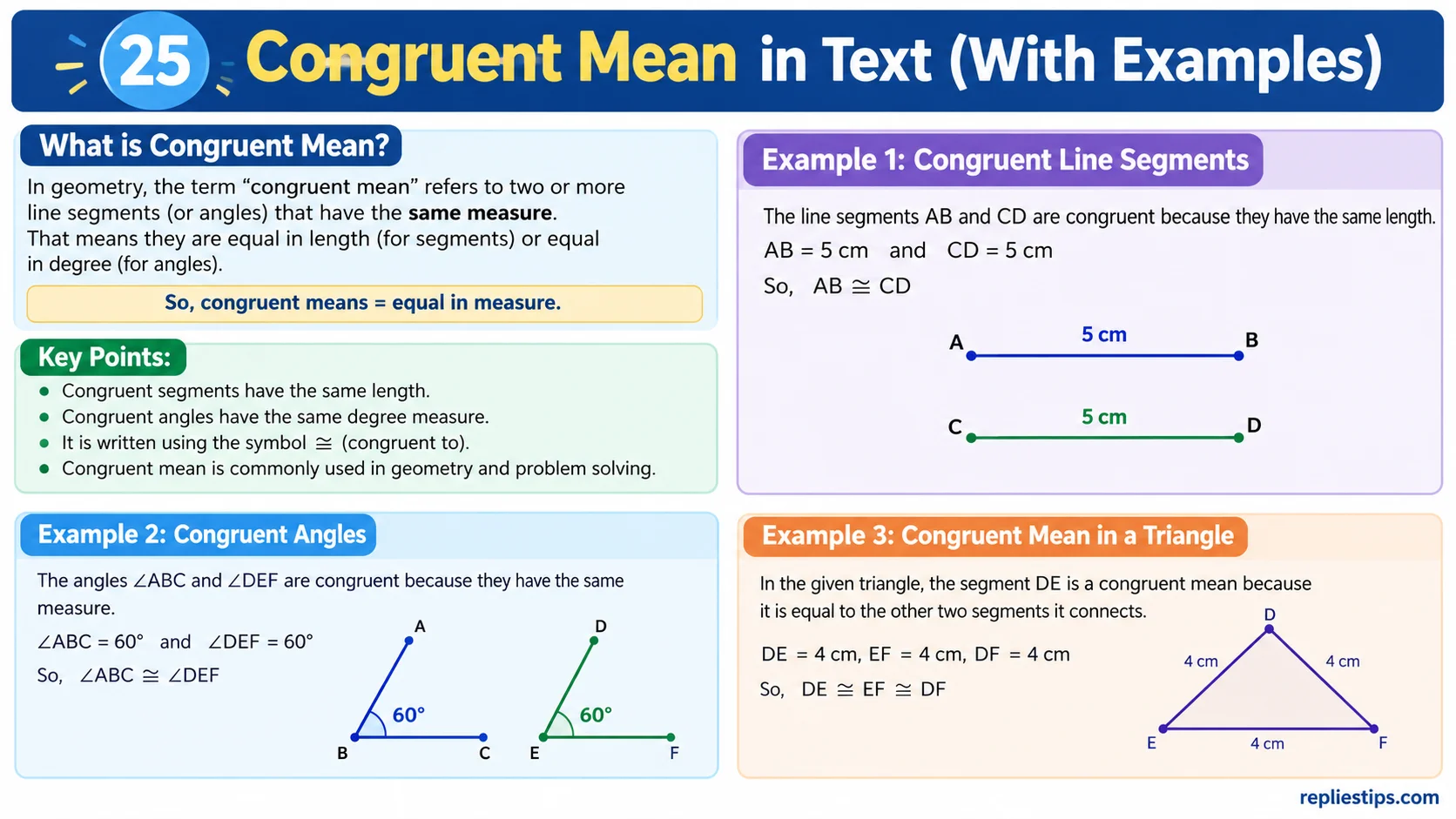
Congruent Mean in Text (With Examples) explains how things match, agree, or fit together logically. The word congruent is used in everyday English, professional conversations, and communication when ideas or actions show consistency. Its meaning depends on the context, so you may find it in math books, psychology articles, and casual discussions. For example, when someone’s words match their actions, they are congruent. Understanding this word helps you recognize logical agreement and avoid common mistakes in daily speech.
In geometry, congruent shapes have the same shape and size. One shape can be rotated, reflected, or translated to fit exactly onto another shape. These movements preserve the shapes’ measurements and spatial relationships. Two line segments are congruent when they have equal lengths, while two angles are congruent when they have equal measures. Similarly, two triangles are congruent when their corresponding sides and angles are equal. These mathematical rules make comparing geometric figures easier.
1. Congruent Meaning in Text
The word congruent describes things that match, agree, or fit together in a consistent way. In texting, someone might use it to explain that two opinions, actions, or ideas are aligned. Although the word sounds formal, it can communicate a simple message: two things make sense together. For example, if a friend says your actions are congruent with your values, they mean you behave according to what you believe. Understanding the context is important because the word can describe emotions, behavior, opinions, mathematical shapes, or logical relationships. It is not a standard abbreviation with one fixed texting definition.
Meaning: Matching, consistent, or in agreement.
Tone: Neutral, thoughtful, or formal.
Example: “Your actions are congruent with your beliefs.”
Best Use: Explaining when someone’s behavior or ideas match their values.
2. Congruent Meaning in Chat
In online chats, congruent can describe a situation in which two messages, opinions, or explanations agree with each other. Imagine discussing weekend plans with a friend. You suggest visiting a quiet café, and your friend says the idea is congruent with their preference for peaceful places. They mean your suggestion matches what they enjoy. Because the word is relatively formal, it may sound unusual in casual conversations. However, it can be useful when you want to express a precise relationship between two ideas. The surrounding sentence usually reveals whether the person means agreement, compatibility, or consistency.
Meaning: Ideas or messages that fit together.
Tone: Conversational but somewhat formal.
Example: “That explanation is congruent with what you told me earlier.”
Best Use: Comparing messages, plans, or statements in an online conversation.
3. Congruent Meaning on Social Media
On social media, congruent may describe content that matches someone’s personality, public image, opinions, or values. For example, a creator who regularly promotes environmental protection might share a post about reducing plastic waste. Followers could describe that post as congruent with the creator’s usual message. The word does not have a special Instagram, TikTok, Snapchat, or Facebook meaning. Instead, it retains its ordinary English definition. Understanding this distinction helps prevent confusion when reading captions, comments, or discussions. If someone uses the word online, consider what two things they are comparing before deciding exactly what they mean.
Meaning: Consistent with someone’s image, values, or message.
Tone: Analytical or approving.
Example: “This campaign is congruent with her personal values.”
Best Use: Discussing social media content, public statements, or personal branding.
4. Congruent Meaning in Relationships
In relationships, congruent often refers to compatibility between feelings, words, actions, and values. A person might say that a partner’s behavior is congruent with their promises when they consistently do what they say they will do. The word can also describe two people whose expectations and priorities align. For example, partners who both value honest communication may have congruent expectations about discussing problems. However, congruence does not mean that two people must agree about everything. They can have different preferences while remaining respectful and compatible. In this context, the term emphasizes consistency and alignment rather than complete similarity.
Meaning: Consistency or compatibility between partners.
Tone: Reflective and sincere.
Example: “His actions are congruent with the promises he made.”
Best Use: Discussing trust, shared values, communication, and relationship compatibility.
5. Congruent Meaning in Friendship
When describing friendship, congruent can mean that two friends share compatible expectations, values, or communication styles. For example, one friend might appreciate direct conversations while the other prefers honest and respectful feedback. Their approaches may be congruent because both value openness. The word can also describe behavior that matches what someone has previously said. If a friend promises to help and follows through, their actions are congruent with their words. This term is more formal than everyday expressions such as “we get along” or “we see eye to eye,” but it can be useful when explaining why a friendship feels comfortable and dependable.
Meaning: Compatible values or consistent behavior between friends.
Tone: Positive and thoughtful.
Example: “Our views on loyalty are pretty congruent.”
Best Use: Explaining shared values and mutual understanding in friendships.
6. Congruent Meaning in Love
In romantic conversations, congruent can describe feelings and actions that agree with one another. Someone may express love through affectionate words, consistent attention, and supportive behavior. When those actions match their statements, their behavior can be described as congruent. The term may also refer to partners whose long-term goals, expectations, or emotional needs are compatible. It does not automatically mean that a relationship is perfect or destined to succeed. Instead, it highlights a connection between what people feel, say, and do. In everyday texting, simpler phrases such as “your actions match your words” may sound more natural.
Meaning: Alignment between feelings, words, and behavior.
Tone: Affectionate, reflective, or serious.
Example: “Your actions are congruent with the love you express.”
Best Use: Discussing emotional honesty and consistency in romantic relationships.
7. Congruent Meaning in Psychology
In psychology, congruence commonly refers to consistency between a person’s experiences, feelings, self-perception, or outward behavior. The exact definition depends on the psychological theory being discussed. In person-centered therapy, congruence is associated with authenticity and alignment between a person’s inner experience and their expressed self. For instance, someone who honestly acknowledges feeling disappointed instead of pretending to be happy may be expressing congruence. If you encounter this term in a psychological article or conversation, consider the specific theory and context. It is a technical concept in some settings, not simply another word for being happy or emotionally healthy.
Meaning: Alignment between internal experience and outward expression.
Tone: Professional and analytical.
Example: “The therapist discussed congruence between feelings and behavior.”
Best Use: Psychology discussions, personal development, and therapy-related educational content.
8. Congruent Meaning in Communication
In communication, congruent describes verbal and nonverbal messages that support one another. Imagine someone saying, “I’m happy to help,” while speaking warmly and behaving supportively. Their words and behavior appear congruent. If the same person says those words while rolling their eyes and refusing to help, the signals may seem incongruent. This distinction matters because people often interpret facial expressions, gestures, tone of voice, and actions alongside spoken language. In text messages, body language is missing, so readers rely on wording, punctuation, and context. Congruent communication generally feels consistent and clear because the different signals do not contradict one another.
Meaning: Agreement between words, tone, and behavior.
Tone: Informative and professional.
Example: “Her friendly words were congruent with her actions.”
Best Use: Discussing interpersonal communication and clear messaging.
9. Congruent Meaning in Education
In education, congruent often describes a match between learning objectives, teaching activities, and assessment methods. For example, if a lesson teaches students how to solve equations, an assessment requiring them to solve similar equations may be congruent with the lesson objectives. The word can also appear in classroom discussions about ideas that agree with evidence or previously established information. Students may encounter it in textbooks, assignments, mathematics, and academic writing. Although it sounds complicated at first, the basic idea is straightforward: the parts fit together appropriately. Understanding this meaning can help students interpret instructions and explain relationships between concepts.
Meaning: Proper alignment between educational goals and activities.
Tone: Academic and explanatory.
Example: “The test is congruent with the lesson objectives.”
Best Use: School assignments, teaching discussions, and educational planning.
10. Congruent Meaning in Mathematics
In mathematics, congruent has a precise meaning. Two geometric figures are congruent when they have the same shape and size, even if one is rotated, reflected, or moved to another position. For example, two triangles can be congruent if their corresponding sides and angles match. This is different from saying that two shapes simply look similar. Similar figures can have the same shape but different sizes, while congruent figures match in both shape and size. When the word appears in a math-related text message, homework discussion, or classroom group chat, it usually refers to this mathematical definition rather than general agreement.
Meaning: Having the same shape and size in geometry.
Tone: Technical and educational.
Example: “These two triangles are congruent.”
Best Use: Geometry lessons, mathematics homework, and discussions of shapes.
11. Congruent Meaning in Texting Conversations
When someone uses congruent in a text message, they usually mean that two things are consistent or compatible. However, the word is not a commonly established texting abbreviation, so readers should not assume it has a hidden slang meaning. A message such as “That is congruent with my understanding” simply means the statement agrees with what the sender understands. In casual conversations, people may prefer “that matches,” “that makes sense,” or “I agree.” Still, congruent can be appropriate when discussing complicated ideas or when someone wants a more precise word. The intended meaning depends on the sentence surrounding it.
Meaning: Consistent with another statement or idea.
Tone: Neutral and slightly formal.
Example: “Your answer is congruent with mine.”
Best Use: Explaining agreement or consistency in written conversations.
12. Congruent Meaning in Professional Messages
In professional communication, congruent can help explain whether a proposal, decision, or action aligns with an organization’s goals. For example, a manager might describe a marketing strategy as congruent with the company’s brand values. This means the strategy supports the image and principles the business wants to communicate. The term is especially useful in reports, project discussions, business emails, and strategic planning. However, it may sound unnecessarily formal in a short message between colleagues. When clarity matters more than technical language, “aligned with” or “consistent with” may be better choices.
Meaning: Aligned with professional goals or standards.
Tone: Formal and businesslike.
Example: “The proposal is congruent with our business objectives.”
Best Use: Workplace emails, presentations, project planning, and business reports.
13. Congruent Meaning in Emotional Expression
When discussing emotions, congruent describes a situation in which someone’s expressed feelings match their actual emotional experience. For instance, a person who feels excited and openly expresses that excitement may be showing emotional congruence. By contrast, someone who feels upset but insists that everything is fine may be communicating something inconsistent with their internal experience. Emotional expression can be complicated, and people sometimes hide feelings for privacy, safety, or social reasons. Therefore, a difference between someone’s emotions and words does not automatically mean they are dishonest. The term simply helps describe whether an expressed emotion appears to match the experience being discussed.
Meaning: Consistency between felt and expressed emotions.
Tone: Reflective and empathetic.
Example: “Her smile and excitement seemed congruent.”
Best Use: Talking about emotional awareness, authenticity, and self-expression.
14. Congruent Meaning in Personal Values
The word congruent can describe a person’s choices matching their core values. Suppose someone believes in fairness and treats coworkers respectfully, even when disagreements arise. Their behavior is congruent with their belief in fairness. This idea often appears in conversations about integrity, personal growth, leadership, and decision-making. It can also help people reflect on whether their daily routines support their priorities. Congruence does not require a person to act perfectly at all times. Instead, it describes a general relationship between what someone considers important and how they choose to behave. This meaning is especially useful in reflective or motivational discussions.
Meaning: Actions that align with personal beliefs and principles.
Tone: Thoughtful and encouraging.
Example: “Your decisions are congruent with your values.”
Best Use: Personal development, leadership, and discussions about integrity.
15. Congruent Meaning in Agreement
In everyday English, congruent can express agreement between statements, opinions, or pieces of information. If two people describe an event in ways that support the same conclusion, their accounts may be congruent. However, congruent does not always mean that the wording is identical. Two explanations can use different words while communicating compatible ideas. This distinction makes the term useful when comparing arguments, reviewing evidence, or discussing a shared understanding. In a casual chat, “we agree” or “our opinions match” is usually simpler. In a formal discussion, congruent may offer a more precise description of how two statements relate.
Meaning: Agreement or consistency between ideas.
Tone: Neutral and analytical.
Example: “Your conclusion is congruent with the available evidence.”
Best Use: Discussions, debates, research, and comparisons of opinions.
Read More: 25 CC Mean in Email (With Examples)
16. Congruent Meaning in Compatibility
Congruent can describe two things that work well together because their characteristics, requirements, or purposes are compatible. For example, a person’s schedule might be congruent with a proposed meeting time, or a product’s features might be congruent with a customer’s needs. This use extends beyond relationships and personal beliefs. It can describe plans, systems, expectations, and practical decisions. Still, compatibility is not always identical to congruence in every technical context. The intended meaning depends on what is being compared. In everyday communication, the term generally suggests that the two things fit together without a major conflict.
Meaning: Suitable or compatible with another thing.
Tone: Practical and neutral.
Example: “This schedule is congruent with my availability.”
Best Use: Comparing plans, requirements, expectations, and practical options.
17. Congruent Meaning in Logic
In logical discussions, congruent may describe statements or arguments that are consistent with one another. For example, a conclusion may be congruent with the evidence presented in an argument. This does not necessarily prove that the conclusion is correct; it means that the ideas appear to fit together. Logical consistency is important when evaluating claims, identifying contradictions, and building clear explanations. The precise technical meaning can vary across fields, so it is important not to treat congruent as a universal synonym for logically valid. In everyday messages about reasoning, however, it often means that an idea agrees with the facts or assumptions being discussed.
Meaning: Consistent with a logical explanation or set of claims.
Tone: Analytical and intellectual.
Example: “That conclusion is congruent with the facts presented.”
Best Use: Reasoning, debates, academic writing, and evaluating arguments.
18. Congruent Meaning in Workplace Behavior
At work, congruent behavior occurs when someone’s actions match the standards, expectations, or professional values they express. For instance, a team leader who emphasizes collaboration and actively listens to employees demonstrates behavior congruent with that principle. The word can also describe an employee’s conduct aligning with a company’s stated mission. It does not mean that every employee must share the same personality or working style. Different approaches can still support the same objective. In workplace discussions, congruence is useful for describing consistency between expectations and actual conduct, particularly when trust, accountability, and leadership are important.
Meaning: Behavior that matches professional expectations or stated values.
Tone: Professional and constructive.
Example: “His leadership style is congruent with the team’s collaborative culture.”
Best Use: Performance reviews, leadership discussions, and workplace feedback.
19. Congruent Meaning in Social Compatibility
In social situations, congruent can describe people or behaviors that fit a particular environment. For example, a respectful and quiet approach may be congruent with a formal ceremony, while a lively and playful approach may suit a casual celebration. This does not mean one personality is better than another. It simply means that a particular behavior fits the setting or social expectations. The word can also describe compatible attitudes between people who enjoy similar activities or share common priorities. In ordinary conversations, phrases such as “a good fit” or “on the same wavelength” may communicate the same general idea more naturally.
Meaning: Fitting a social situation or shared expectations.
Tone: Observational and neutral.
Example: “His respectful behavior was congruent with the occasion.”
Best Use: Discussing social settings, group dynamics, and interpersonal compatibility.
20. Congruent Meaning in Online Discussions
During online debates or forum conversations, congruent can describe comments that agree with earlier information or support a particular argument. For instance, someone might say that a new explanation is congruent with the details shared earlier in a discussion. The word can help distinguish between statements that support one another and statements that contradict one another. However, agreement alone does not guarantee accuracy. Two people can share the same mistaken assumption, so evidence still matters. When reading online discussions, examine the full context before interpreting congruent as proof that a claim is true or universally accepted.
Meaning: Consistent with information already discussed.
Tone: Analytical and measured.
Example: “Your comment is congruent with the earlier explanation.”
Best Use: Online forums, discussion threads, and evidence-based conversations.
21. Congruent Meaning in Writing
In writing, congruent can describe consistency between a writer’s message, purpose, tone, and supporting evidence. For example, a formal research report should generally use language appropriate to its academic purpose. If the tone, examples, and conclusions support the same objective, the writing may be described as congruent. The term can also be used when comparing a writer’s claims with the evidence included in the text. Writers should remember that congruence does not automatically guarantee good writing. Organization, clarity, accuracy, and audience awareness remain important. Nevertheless, the concept can help writers check whether the parts of a document work together effectively.
Meaning: Consistency between a written message and its purpose.
Tone: Academic and explanatory.
Example: “The article’s tone is congruent with its educational purpose.”
Best Use: Essays, articles, reports, editing, and content planning.
22. Congruent Meaning in Decision-Making
When making decisions, congruent describes choices that align with a person’s goals, priorities, or available information. Imagine someone who wants to save money and chooses a less expensive option that meets their needs. That choice may be congruent with their financial priorities. The word is useful because it focuses on the relationship between a decision and the reasons behind it. However, a decision that matches one goal may conflict with another, so context matters. People often balance several priorities at once. In everyday conversations, congruent can help explain why a particular choice makes sense given someone’s stated intentions.
Meaning: A decision that aligns with goals or priorities.
Tone: Practical and thoughtful.
Example: “This decision is congruent with my long-term goals.”
Best Use: Planning, problem-solving, and explaining personal or professional choices.
23. Congruent Meaning in Self-Expression
Congruent self-expression means communicating in a way that reflects what you genuinely think, feel, or believe. For example, someone who values honesty might share a respectful and truthful opinion rather than pretending to agree with everyone. This does not require revealing every private feeling or speaking without considering other people’s needs. Authentic expression can still include tact, discretion, and kindness. The key idea is that the message a person chooses to express is reasonably consistent with their genuine perspective. In personal development discussions, congruence can help explain why authenticity and thoughtful communication often contribute to stronger relationships.
Meaning: Expressing yourself in a way that reflects your genuine perspective.
Tone: Personal and encouraging.
Example: “Her words were congruent with how she truly felt.”
Best Use: Personal growth, honest conversations, and discussions about authenticity.
24. Congruent vs. Incongruent Meaning in Text
Understanding congruent becomes easier when you compare it with its opposite, incongruent. Congruent describes things that match or remain consistent, while incongruent describes things that do not fit together or appear inconsistent. For example, a person’s statement that they are excited may seem congruent with enthusiastic behavior. If they appear visibly uncomfortable while repeatedly claiming to be delighted, the signals may seem incongruent, although their behavior alone cannot establish what they truly feel. This comparison is useful in texting, psychology, communication, and everyday English. Looking at both terms helps readers understand the relationship being described rather than memorizing an isolated definition.
Meaning: Congruent means matching; incongruent means inconsistent or mismatched.
Tone: Educational and comparative.
Example: “His actions were congruent with his promises, not incongruent with them.”
Best Use: Learning vocabulary, comparing behavior, and explaining contradictions.
25. How to Use Congruent Naturally in Text Messages
Although congruent is a useful word, it may sound overly formal in a conversation with close friends. Before using it, consider your audience and the point you want to make. If you are discussing personal values, an academic topic, professional plans, or consistency between words and actions, the word may fit well. For casual texting, simpler alternatives such as “matching,” “consistent,” “aligned,” or “in agreement” may sound more natural. For example, instead of writing “Your plan is congruent with mine,” you could say, “Our plans match.” Choosing the right expression makes your message easier to understand and helps you communicate without unnecessary complexity.
Meaning: Using “congruent” to express consistency or alignment.
Tone: Formal, thoughtful, or educational.
Example: “That idea is congruent with what we discussed.”
Best Use: Choose the word when precision matters; use simpler alternatives for casual conversations.
FAQs:
1. What does congruent mean in text messages?
Congruent means matching, consistent, or in agreement. In a text message, it may describe ideas, opinions, feelings, or actions that fit together.
2. Is congruent a texting abbreviation?
No. Congruent is a standard English word, not a widely recognized texting abbreviation like LOL or BRB.
3. What does congruent mean in slang?
Congruent does not have one established slang meaning. People generally use its ordinary meaning of matching, aligning, or being consistent.
4. What is an example of congruent in a sentence?
“Your actions are congruent with your words” means that what you do matches what you say.
5. What does congruent mean in a relationship?
It usually describes consistency between partners’ feelings, words, values, or actions. It can also describe compatible expectations.
6. What is the opposite of congruent?
Incongruent is a common opposite. It describes things that do not match, fit together, or remain consistent.
7. What does congruent mean in psychology?
In some psychological contexts, congruence refers to alignment between a person’s inner experiences, self-perception, and outward expression.
8. What does congruent mean in mathematics?
In geometry, congruent figures have the same shape and size, even when their positions or orientations differ.
9. Can I use congruent in casual texting?
Yes, but it may sound formal. Words such as “matching,” “consistent,” and “aligned” are often easier to use in casual chats.
10. Does congruent mean exactly the same?
Not always. In everyday language, it often means consistent or compatible. In geometry, however, congruent figures have the same shape and size.
Conclusion:
Understanding 25 Congruent Mean in Text helps you recognize how the word is used in messaging, relationships, psychology, education, mathematics, and professional communication. Its central meaning is matching, consistent, or in agreement, although the precise definition depends on the context. Remember that congruent is not a standard texting abbreviation or a special slang expression. It is a regular English word that describes a relationship between ideas, actions, feelings, or objects. When writing messages, choose it when you want to communicate clearly and precisely. For everyday chats, simpler alternatives such as “matching,” “consistent,” and “aligned” can often express the same idea more naturally.














1 thought on “25 Congruent Mean in Text (With Examples)”